
MARKETING TRANSLATION & TRANSCREATION Translation and transcreation are not competing versions of the In multilingual campaigns, the right choice depends on the content, |
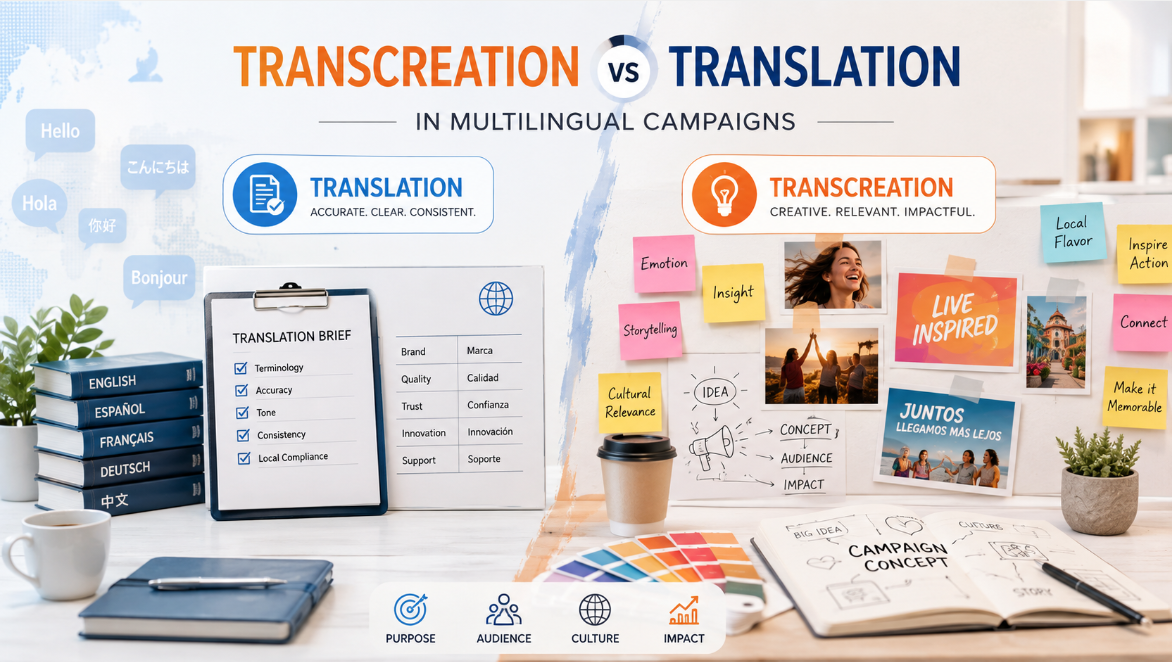
Strong multilingual campaigns often use both approaches: translation
where factual precision matters and transcreation where persuasion,
memorability, emotion or cultural relevance is the primary objective.
This guide explains how to decide which approach fits each campaign asset
and how to brief a translation or transcreation team effectively.
QUICK OVERVIEW
Translation or Transcreation: Which One Do You Need?
Translation
Best when the priority is accuracy, clarity, consistency
and faithful transfer of source meaning.
Transcreation
Best when the priority is audience response, persuasion,
creativity, memorability or cultural resonance.
Hybrid Approach
Many campaigns combine both: factual content is translated,
while headlines, slogans and creative copy are transcreated.
Briefing Matters
The more creative freedom a project allows, the more important
the campaign brief, brand guidance and approval process become.
THE CORE DIFFERENCE
Translation Reproduces Meaning; Transcreation Recreates Effect
Professional translation aims to communicate the source content
accurately and naturally in another language. The wording can change
where grammar and idiom require it, but the underlying message remains
closely controlled by the source.
Transcreation begins with the same source message but allows greater
creative adaptation when a literal or close translation would not
produce the desired reaction in the target market.
That can involve changing wordplay, imagery, rhythm, cultural references,
examples or the structure of the message while preserving the campaign’s
intended strategic purpose.
Translation Focus
Meaning, terminology, accuracy, consistency and readability.
Transcreation Focus
Audience, emotional effect, memorability, brand voice and cultural fit.
Source Relationship
Translation stays closer to the source wording; transcreation has more creative latitude.
Approval Process
Transcreation often benefits from options, rationale and stakeholder review.
WHEN TRANSLATION IS THE BETTER FIT
Use Translation When Precision Is the Primary Goal
Product SpecificationsFeatures, dimensions, technical data and product facts need controlled meaning.
Instructions & ManualsUser guidance should remain accurate and consistent with the source procedure.
Corporate InformationCompany profiles, factual announcements and business descriptions.
Legal & Policy ContentTerms, agreements and formal policies generally require source fidelity.
Financial InformationFigures, financial statements and reporting content require precise terminology.
Help & Support ContentFAQs and troubleshooting content should prioritize clarity and consistency.
WHEN TRANSCREATION IS THE BETTER FIT
Use Transcreation When the Audience Response Is the Goal
Creative marketing is often designed to make people feel something:
curiosity, urgency, trust, excitement, aspiration or identification
with a brand.
If the source message depends on humor, wordplay, rhythm, cultural
references or a distinctive creative concept, a close translation
may preserve the words but lose the campaign effect.
In those cases, the transcreator can work from the campaign strategy
rather than treating every source sentence as fixed wording.
Slogans & Taglines
Short creative lines where memorability and brand fit matter.
Advertising Headlines
Paid campaigns where attention and persuasion are central.
Brand Campaigns
Creative concepts designed to build emotional connection or recognition.
Social Creative
Short-form campaign content influenced by tone, culture and local conventions.
HYBRID CAMPAIGNS
One Campaign Can Require Several Linguistic ApproachesA product launch may contain a slogan, landing page, press release, Applying full creative freedom to every asset would create unnecessary A better approach is to classify content by communication goal |
Slogan → Transcreation
Ad headline → Transcreation / creative adaptation
Product features → Translation
Press release → Translation + editorial localization
Legal disclaimer → Controlled translation
|
THE CREATIVE BRIEF
Transcreation Needs More Context Than Ordinary Source Text
A transcreator needs to understand what the campaign is trying to achieve,
who the audience is and which parts of the message are fixed.
A source sentence alone may not explain whether the priority is premium
positioning, urgency, humor, trust, product education or another brand objective.
The stronger the brief, the easier it is to create target-language
alternatives that can be evaluated against the same strategic goal.
Campaign Goal
Awareness, engagement, lead generation, launch, conversion or brand building.
Target Audience
Who the campaign is speaking to and what matters to that audience.
Brand Voice
Formal, premium, playful, technical, bold, understated or another defined style.
Creative Boundaries
Clarify what may change and what must remain exactly controlled.
CULTURAL RELEVANCE
A Strong Creative Idea May Need a Different Local Expression
The goal of transcreation is not to change content merely for the sake
of being different. Adaptation should solve a real communication problem.
HumorJokes and wordplay may need a new mechanism to create a similar reaction.
IdiomsSource expressions can be replaced when a literal rendering would confuse users.
Cultural ReferencesReferences unfamiliar to the target market may need adaptation or removal.
SeasonalityCampaign timing, holidays and local events can affect the relevance of creative copy.
Visual MeaningCopy should be reviewed together with imagery when the creative concept depends on both.
SensitivityLocal language can carry associations or connotations not obvious in the source market.
BRAND VOICE
Creative Freedom Still Needs Brand Control
Transcreation is not unrestricted rewriting. The target copy should
still sound like the same brand and support the same strategic position.
Brand guidelines can help define preferred vocabulary, tone,
prohibited language, capitalization, product naming and other
recurring communication rules.
Where several markets are involved, a shared brand framework can
prevent each language version from becoming a completely different campaign.
Tone
Keep the localized voice aligned with the brand personality.
Terminology
Maintain approved product names and recurring campaign terms.
Do-Not-Translate Terms
Identify trademarks, product names and protected expressions.
Message Hierarchy
Keep primary claims and supporting benefits aligned with campaign strategy.
CREATIVE OPTIONS
For High-Value Copy, One Target Version May Not Be Enough
Slogans, campaign headlines and other high-impact copy can benefit
from several target-language options rather than a single proposed line.
Each option can emphasize a slightly different balance of meaning,
memorability, tone or cultural fit while staying within the same brief.
A short rationale helps the marketing team understand why each option
works and what trade-offs it makes compared with the source.
CLAIM CONTROL
Creative Adaptation Must Not Invent New Product Claims
Transcreation gives more freedom over expression, but that freedom
should not extend to creating unsupported performance claims,
guarantees or factual statements.
Product benefits, numerical claims, pricing, legal statements and
regulated information should remain controlled by approved source information.
If a creative concept depends on changing a substantive claim,
the change should be approved explicitly by the responsible client team.
Numbers
Keep statistics, prices, percentages and performance figures accurate.
Product Claims
Do not add benefits or guarantees that are not approved in the source.
Legal Copy
Formal terms and disclaimers should use a controlled translation workflow.
Regulated Content
Market-specific legal or regulatory review may be required separately.
IN-MARKET REVIEW
Creative Copy Should Be Reviewed in Context Before Launch
A slogan can look strong in a spreadsheet and still feel awkward
when placed on an advertisement, landing page or social creative.
Reviewing the localized message together with imagery, layout,
character limits and surrounding content helps reveal issues before launch.
High-value campaigns may also benefit from local stakeholder feedback
or structured testing when several creative options are available.
Visual Review
Check the copy together with the actual campaign design.
Native-Market Review
Use informed local feedback for tone and cultural fit where appropriate.
Character Limits
Confirm that headlines and ad copy fit their intended channels.
Performance Testing
Where suitable, compare creative options using campaign data after launch.
BKMOS WORKFLOW
Multilingual Campaign Translation & Transcreation Workflow
1
Campaign Review
Review objectives, target markets, audience, assets and creative constraints.
2
Content Classification
Decide which assets need translation, transcreation or a hybrid approach.
3
Translation / Transcreation
Create target copy using the appropriate level of source fidelity and creative freedom.
4
Review & In-Context QA
Review terminology, brand voice, factual claims and final campaign presentation.
PROJECT CHECKLIST
Before Sending a Multilingual Campaign for Adaptation
A clear campaign brief helps the language team choose the right
approach and prevents unnecessary rewriting or overly literal translation.
RELATED RESOURCES
Related BKMOS Multilingual Content Resources
while preserving facts, quotes and media readability.
Press Release Translation →
and technical SEO work together.
Website Translation & SEO →
websites, apps and multilingual digital content.
Localization Services →
FREQUENTLY ASKED QUESTIONS
Translation vs Transcreation FAQs
Is transcreation simply a more creative translation?
Not exactly. Transcreation gives the language team greater freedom to
recreate the campaign effect when close translation would not work in
the target market.
Does every marketing text need transcreation?
No. Product facts, specifications, policies and informational content
often need translation rather than broad creative adaptation.
Which content is most suitable for transcreation?
Slogans, taglines, advertising headlines, brand campaigns and other
content where emotional or persuasive impact is central are common candidates.
Can one campaign use both translation and transcreation?
Yes. This is often the most practical approach when the campaign combines
creative assets with factual, technical or formal content.
What should a transcreation brief include?
Include campaign goals, audience, brand voice, required message,
creative references, fixed claims, channels and approval requirements.
What should we send for a quotation?
Send representative campaign assets, target languages, markets,
campaign brief, expected deliverables and launch deadline.
EXPERT REVIEW
Reviewed by Nguyen Dinh Phuc
Founder & CEO of BKMOS. Working in professional translation
since 2005 and responsible for BKMOS’s professional direction,
translation workflows and expert content.
MULTILINGUAL CAMPAIGNS
Translation, Transcreation — or Both?
Send BKMOS representative campaign assets together with the target
markets, languages, creative brief and launch deadline. We will review
the content and help define an appropriate translation or transcreation scope.
