
|
|
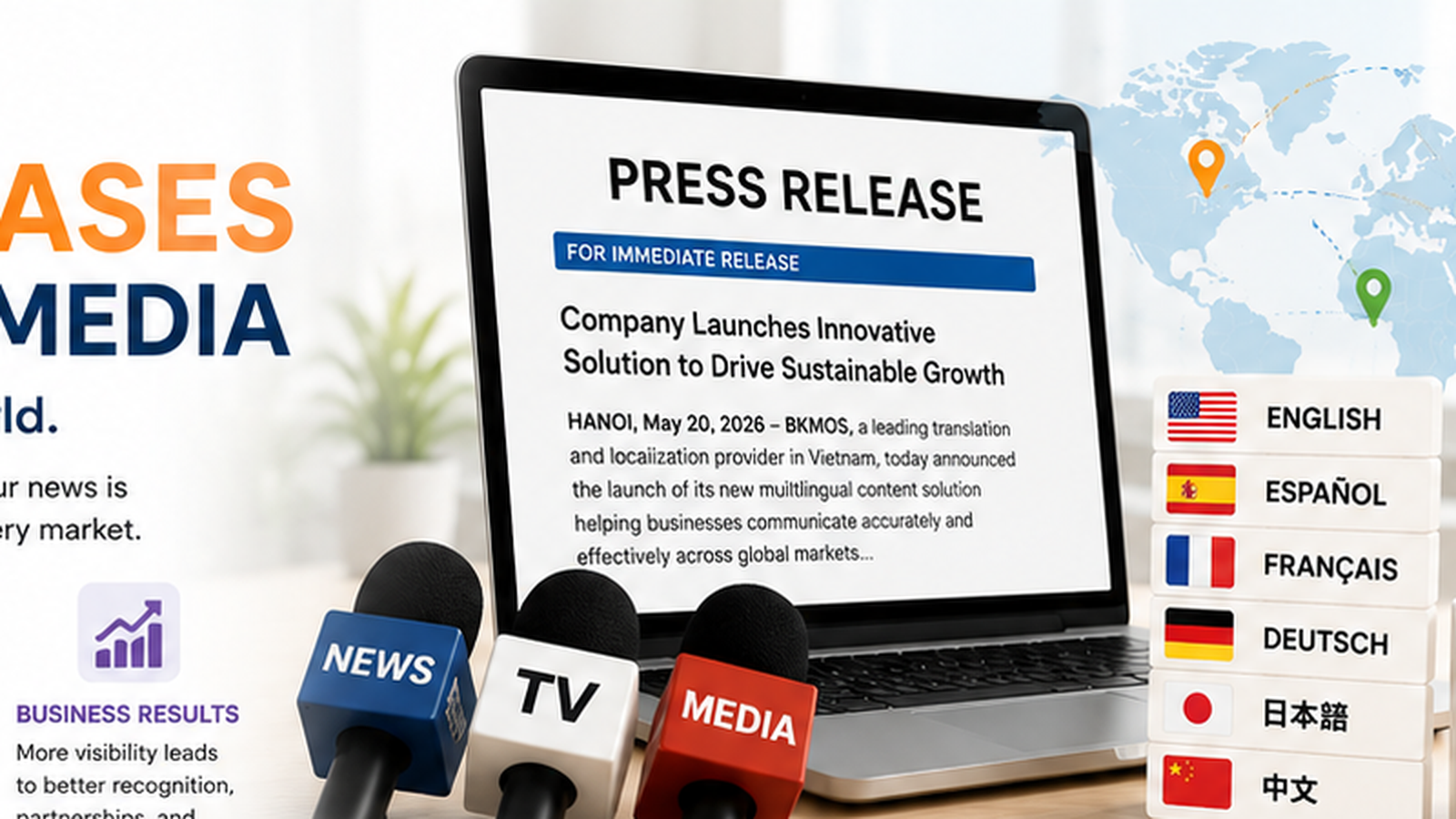
Good media translation does not turn a press release into a new advertisement.
It keeps the source facts and message intact while adapting language,
references and style where necessary for clear international communication.
This guide explains what companies should prepare and review when translating
press releases for foreign journalists, newsrooms and international audiences.
What Matters Most in Press Release Translation?
Fact Accuracy
Names, figures, dates, job titles, locations and factual claims
should be checked carefully against the source release.
Newsroom Readability
The translated release should read naturally and clearly without
sounding like a literal word-for-word rendering.
Quote Integrity
Executive quotations should preserve the speaker’s meaning,
tone and level of certainty.
Deadline Control
Media releases are time-sensitive, so translation and approval
workflows need to match the planned publication schedule.
Translate the Whole Release, Not Just the Main Paragraphs
A press release contains several elements that work together:
headline, subheadline, dateline, lead paragraph, body copy,
quotations, company background, contact details and sometimes links
to supporting media assets.
If only the body text is localized while the headline, boilerplate
or media contact section remains inconsistent, the final release can
feel incomplete or difficult for foreign journalists to use.
Before translation starts, confirm which elements belong to the
release package and which items should remain unchanged.
Headline & Subheadline
Communicate the core news clearly without adding claims not present in the source.
Dateline & Lead
Keep location, date and opening facts clear and easy to verify.
Quotes
Preserve the speaker’s intent, tone and attribution.
Boilerplate & Contact
Keep company background and media-contact information consistent.
Press Releases Cover Many Types of Corporate News
New products, services, platforms and major feature announcements.
Leadership changes, company milestones, expansion and organizational news.
Results, investment announcements and other company financial updates.
Strategic partnerships, joint ventures, acquisitions and investment news.
Industry recognition, conferences, sponsorships and corporate events.
Community programs, sustainability initiatives and social-impact announcements.
A Headline May Need Adaptation, Not Literal Translation
Press-release headlines often use compact wording, industry terminology
and a specific news angle. A literal translation can preserve every word
but still sound unnatural or obscure the main announcement.
The target-language headline should communicate the same news value
and factual meaning without exaggerating the source.
If the release will also be published on the company’s website,
search-facing wording can be reviewed separately from the newsroom headline.
Keep the News Angle
Make the primary announcement clear from the beginning.
Avoid Added Claims
Do not strengthen statements beyond what the source release actually says.
Use Natural Syntax
Rewrite sentence structure when needed for clear target-language reading.
Review Length
Keep the headline practical for email, newsroom and website use.
Journalists Need Details They Can Trust
Press releases often contain dense factual information.
Translation QA should therefore include structured checking beyond ordinary proofreading.
Executives, companies, products, partners and organizations.
Job titles, professional roles and organizational positions.
Announcement dates, launch dates, event dates and reporting periods.
Revenue, investment values, percentages, growth figures and quantities.
Cities, countries, facilities, markets and geographic references.
Media URLs, corporate websites, email addresses and phone details.
|
EXECUTIVE QUOTATIONS
Preserve the Speaker’s Meaning and Level of Commitment
|
Meaning → Preserve accurately
Tone → Keep appropriate to the speaker
Certainty → Do not strengthen or weaken
Attribution → Verify name and job title
Approval → Confirm when required
|
Localize References That May Not Travel Well
A foreign journalist may not recognize a local acronym, organization,
geographic reference or market-specific business term that is obvious
to readers in the source country.
Where clarification is genuinely needed, the translation can use an
established target-language name or a concise explanatory rendering,
while staying faithful to the source.
Company names, official product names and registered brands should
follow approved forms rather than being translated casually.
Organization Names
Use official English or target-language names where reliably available.
Local Acronyms
Clarify only when the target audience would not reasonably understand them.
Geographic References
Use clear place names and accepted target-language forms.
Product & Brand Names
Follow approved naming conventions and do-not-translate lists.
Clear Corporate Language Is Usually Better Than Promotional Overstatement
Press releases need to communicate the company’s message, but foreign
media still need copy that is easy to understand, quote and verify.
The translation should preserve the source tone while avoiding awkward
constructions that make straightforward corporate information sound
exaggerated or unclear.
If the source itself is highly promotional, translation should reflect
that source rather than silently rewriting the company’s communications strategy.
Clarity
Use readable sentences and make the core announcement easy to identify.
Consistency
Keep terminology and company positioning stable across the full release.
Source Fidelity
Do not add claims or remove meaningful qualifications.
Media Readiness
Deliver copy that journalists can review and quote without deciphering literal language.
Make It Easy for Foreign Journalists to Follow Up
The contact block should be checked with the same care as the main release.
An incorrect email address, phone number or job title can prevent a journalist
from reaching the right person.
If a separate international media contact is available, confirm whether
that person should replace or supplement the source-language contact.
Time-zone information or preferred contact methods can also be useful
when the release is distributed internationally.
If the Release Is Published Online, Coordinate It With the Localized Website
Companies often publish the press release on their own website in addition
to sending it to journalists or distribution services.
The translated release should link to the correct localized product,
company or contact pages so foreign readers do not land on unrelated
or untranslated destinations.
Where organic search matters, page titles, metadata and internal links
can be reviewed as part of the localized web version.
Localized Destination
Link readers to the relevant target-language page where one exists.
SEO Title
Write a useful search-facing title for the web version of the release.
Meta Description
Summarize the announcement naturally for search users.
Internal Links
Connect the release to relevant company, product and service pages.
Translate the Approved Release — Not an Outdated Draft
Press releases often change during legal review, executive approval
and final fact-checking. A headline, quotation, figure or publication
date can be updated close to release time.
If translation starts early, the project should include a clear process
for identifying later source changes and updating each target-language version.
The final delivery should be checked against the approved source before distribution.
Press Release Translation Workflow
Source Review
Review the announcement, target markets, media use and deadline.
Terminology Setup
Confirm company names, products, titles, glossary and approved references.
Translation & Editorial QA
Translate and review facts, quotes, terminology, readability and completeness.
Final Version Check
Compare the target release with the approved source before distribution.
Before Sending a Press Release for Translation
A complete handoff helps the translation team move quickly while
protecting factual accuracy and brand consistency.
Related BKMOS Translation Resources
How to coordinate multilingual website content, localized search intent,
hreflang and technical SEO.
Localization of product catalogs, checkout content,
customer support and e-commerce experiences.
Professional translation support for business,
technical and other specialist content.
Press Release Translation FAQs
Should a press release be translated literally?
Not necessarily. Facts and meaning should remain faithful to the source,
but sentence structure may need adaptation so the release reads naturally
for journalists in the target language.
Can headlines be adapted?
Yes, where necessary for clarity and natural target-language style,
provided the adaptation does not add or change the underlying news claim.
How should executive quotes be handled?
The translation should preserve the speaker’s meaning, tone and level
of certainty while reading naturally in the target language.
Can urgent press releases be translated?
Turnaround depends on language pair, length, complexity and approval workflow.
Provide the planned release time when requesting a quotation.
Should the website version also be localized?
If the release will be published on a multilingual website, localized
metadata, internal links and target-language destination pages should be reviewed.
What should we send for a quotation?
Send the latest release draft, target languages, publication deadline,
approved terminology and any required reference materials.
EXPERT REVIEW
Reviewed by Nguyen Dinh Phuc
Founder & CEO of BKMOS. Working in professional translation
since 2005 and responsible for BKMOS’s professional direction,
translation workflows and expert content.
Preparing a Press Release for Foreign Media?
Send BKMOS the latest approved release together with the target
languages, publication deadline and relevant terminology or reference
material. We will review the content and project requirements before quoting.
