
|
|
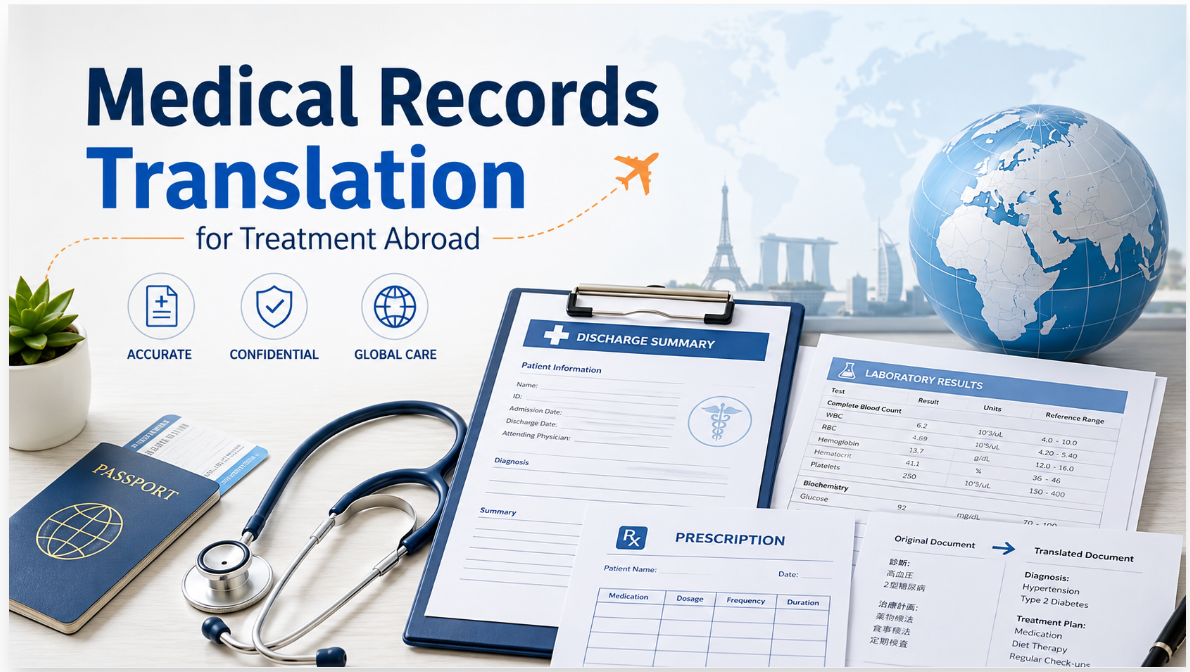
Medical records may include discharge summaries, laboratory reports,
imaging reports, prescriptions, pathology reports, operative notes,
specialist consultations and other clinical documents.
This guide explains the main issues patients, families and healthcare
coordinators should review before preparing medical records for translation
for overseas consultation or treatment.
What Matters Most in Medical Record Translation?
Medical Terminology
Diagnoses, procedures, medications and clinical terminology should
be translated accurately and consistently in context.
Clinical Values
Laboratory values, units, dates and measurements require careful
verification against the source record.
Complete History
Important diagnoses, medications, procedures and follow-up notes
should not be omitted from the translated record.
Confidentiality
Medical records contain sensitive personal information and should
be handled through an appropriate confidential workflow.
What Documents May Need Translation?
The exact document package depends on the patient, medical condition,
treatment plan and requirements of the receiving hospital or clinic.
Some cases involve only a recent medical summary, while others may
require several years of records, test results, imaging reports,
prescriptions and specialist notes.
Before translation begins, identify the documents that are relevant
to the overseas consultation and make sure the copies are complete
and legible.
Discharge Summaries
Diagnoses, hospitalization history, treatment and discharge instructions.
Laboratory Reports
Test names, values, reference ranges, units and collection dates.
Imaging Reports
Radiology, CT, MRI, ultrasound and other diagnostic findings.
Prescriptions
Medication names, strengths, dosage instructions and treatment schedules.
Medical Files Can Include Many Different Record Types
Specimen details, microscopic findings, diagnoses and related comments.
Surgical procedures, findings, techniques and post-operative information.
Specialist assessments, diagnoses, recommendations and follow-up plans.
Clinical confirmations, fitness statements and other formal medical records.
Vaccines, dates, doses and related immunization information.
Past conditions, procedures, allergies, medications and family history.
Context Matters in Clinical Translation
Many medical terms have specialized meanings that depend on the
clinical field, anatomical context, procedure or diagnosis.
Abbreviations can also be difficult because the same abbreviation
may have more than one possible meaning. Where the source is unclear,
the translator should avoid inventing information that is not supported
by the record.
Consistent terminology is particularly important when several documents
describe the same diagnosis, medication, procedure or anatomical site.
Diagnoses
Use terminology appropriate to the medical context shown in the source.
Procedures
Keep surgical and diagnostic procedure names consistent across records.
Medications
Preserve medication names, strengths and dosage information carefully.
Abbreviations
Interpret only when the medical context clearly supports the meaning.
Numbers, Units and Dates Need Structured Verification
A medical translation can be linguistically correct but still create
confusion if clinical values or units are transferred incorrectly.
Reproduce numerical results accurately and keep them aligned with test names.
Keep reference intervals and units associated with the correct test result.
Check strength, quantity, frequency and administration instructions carefully.
Verify examination, admission, discharge and treatment dates.
Preserve sizes, weights, pressures and other clinical measurements accurately.
Check patient name, date of birth, record numbers and related identifiers.
|
TRANSLATION SCOPE
Translation Should Preserve the Medical Record — Not Diagnose It
|
Medical terminology → Translate in context
Clinical values → Preserve and verify
Diagnosis → Do not reinterpret
Treatment advice → Outside translation scope
Medical decisions → Refer to healthcare professionals
|
Prepare the Most Relevant Medical Records First
Patients sometimes have hundreds of pages of medical history.
The receiving hospital may not need every document from every visit.
Where possible, ask the overseas hospital or medical coordinator
which records are most useful for the consultation. This can help
prioritize translation and reduce unnecessary cost and turnaround time.
Clear scans are important. Handwritten notes, faded photocopies and
incomplete pages can make accurate translation more difficult.
Recent Summary
Provide the latest clinical summary when available.
Key Test Results
Include laboratory, imaging and pathology reports relevant to treatment.
Medication List
Provide current medications and related prescriptions where relevant.
Clear Scans
Make sure every page is readable and complete before translation.
Medical Records Contain Sensitive Personal Information
Medical documents can include identity information, diagnoses,
treatment histories, laboratory results and other sensitive data.
Patients and organizations should consider appropriate access control,
secure file transfer and confidentiality requirements before sending
records for translation.
If an NDA or project-specific handling requirement is needed, it
should be discussed before work begins.
Access Control
Limit access to people involved in the translation workflow.
Secure Transfer
Use an appropriate method for transmitting sensitive medical files.
Confidentiality Terms
Confirm NDA or project-specific requirements where applicable.
Final Delivery
Agree on the delivery format and any special file-handling needs.
Medical Record Translation Process
Document Review
Review file types, language pair, volume, legibility and deadline.
Terminology Setup
Identify medical specialty, recurring terms and reference materials.
Translation & QA
Translate and review terminology, values, dates, medications and completeness.
Formatting & Delivery
Review document structure and deliver the final files in the agreed format.
Before Sending Medical Records for Translation
A short preparation step can improve quotation accuracy and help
the translation team prioritize the records needed for treatment abroad.
Related BKMOS Translation Services
Medical, technical, financial and other specialist translation
for professional documents.
Translation support for documents requiring certification
or other formal processing for international use.
Translation of supporting personal and administrative documents
used alongside international travel or treatment arrangements.
Medical Record Translation FAQs
What medical records can BKMOS translate?
Depending on the project and language pair, BKMOS can handle discharge
summaries, laboratory reports, imaging reports, prescriptions, medical
certificates and related clinical documents.
Should every medical record be translated?
Not necessarily. Where possible, ask the receiving hospital which
records are most relevant to the consultation or treatment.
Can laboratory values and units be preserved?
Yes. Numerical values, units and reference ranges should be carefully
transferred and checked against the source document.
Does medical translation include medical advice?
No. Translation reproduces the information in the medical record.
Diagnosis, treatment recommendations and clinical interpretation
should come from qualified healthcare professionals.
Can confidential medical files be handled under an NDA?
Project-specific confidentiality requirements can be discussed before
work begins so an appropriate workflow can be agreed.
What should I send for a quotation?
Send clear sample files, the language pair, intended use, required
format, deadline and any known confidentiality or certification requirements.
EXPERT REVIEW
Reviewed by Nguyen Dinh Phuc
Founder & CEO of BKMOS. Working in professional translation
since 2005 and responsible for BKMOS’s professional direction,
translation workflows and expert content.
This article discusses translation workflow and document preparation.
It does not provide medical advice, diagnosis or treatment recommendations.
Preparing Medical Records for Treatment Abroad?
Send BKMOS your medical records or representative sample files
together with the language pair, intended use, required format
and deadline. We will review the document package and project
requirements before quoting.
