
|
|
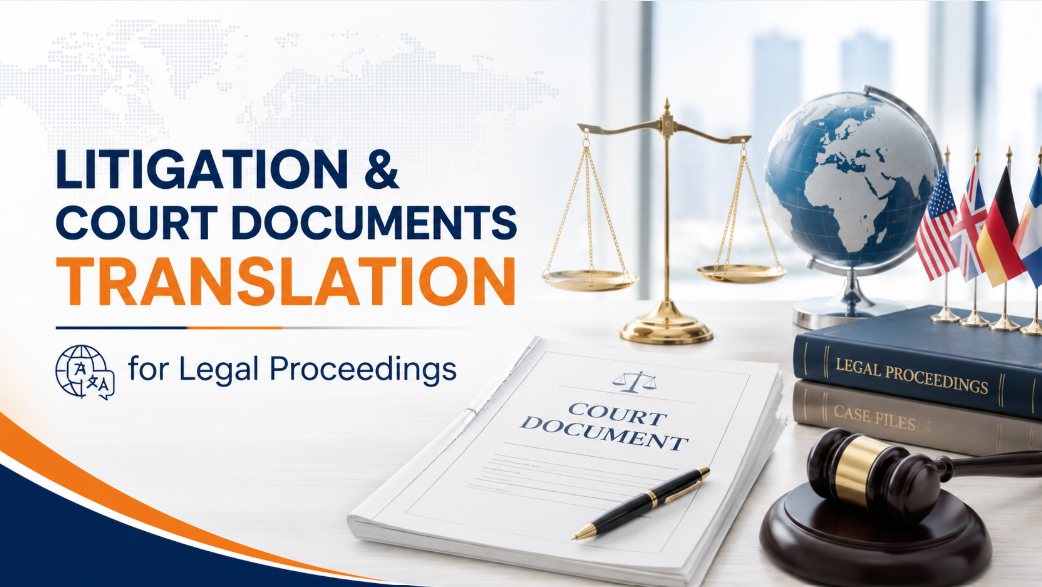
Court-related translation often requires careful document control because
one matter may involve many files, revisions, exhibits and references that
need to remain aligned throughout the translated case package.
This guide explains the main issues law firms, companies and individuals
should review before submitting litigation or court documents for translation.
What Matters Most in Court Document Translation?
Complete Content
Headings, body text, footnotes, stamps, handwritten notes and
attachments should be reviewed for inclusion where relevant.
Legal Terminology
Recurring procedural and legal terms should remain consistent
across related documents in the same matter.
Names & Evidence
Party names, quotations, dates, amounts, exhibit numbers and
evidence references require careful verification.
Deadline Control
Litigation projects may have fixed filing or hearing schedules,
so scope and turnaround should be confirmed early.
What Documents May Need Translation?
A legal proceeding may involve procedural filings, evidence,
correspondence and supporting corporate or personal records.
These documents should be reviewed as a coordinated file set because
the same names, dates, defined terms and exhibit references often appear
repeatedly throughout the matter.
Before translation begins, identify the documents required for the
intended filing or review and confirm the current version of each file.
Pleadings & Petitions
Complaints, answers, motions, petitions and related procedural filings.
Witness Statements
Affidavits, declarations, written testimony and supporting statements.
Evidence & Exhibits
Contracts, emails, invoices, records, photographs and supporting evidence.
Judgments & Orders
Orders, decisions, rulings, judgments and related court documents.
Litigation Files Often Include More Than Court Forms
Technical, medical, financial, engineering and other specialist reports.
Requests, responses, interrogatories and document-production materials.
Formal notices, letters, communications and case-related correspondence.
Agreements, amendments and commercial records forming part of the dispute.
Registrations, resolutions, licenses and company documents.
Identity, civil-status and other personal documents relevant to the matter.
Consistency Matters Across the Entire Case File
A litigation matter can involve dozens or hundreds of documents
produced at different stages. Recurring legal and factual terms
should therefore be managed consistently across the translated record.
Party names, organization names, procedural terminology, technical
terms and recurring factual descriptions may all benefit from a
project glossary or reference list.
Previously approved translations can also help maintain consistency
when the same parties or documents appear in later stages of the matter.
Party Names
Use one approved form consistently across pleadings and evidence.
Procedural Terms
Keep recurring court and process terminology stable throughout the matter.
Defined Terms
Preserve terms already established in contracts or earlier filings.
Specialist Terminology
Coordinate legal language with medical, technical or financial expert content.
Small Errors Can Affect How Evidence Is Read
Litigation translation should include structured checking of names,
figures and references in addition to ordinary linguistic review.
Parties, witnesses, experts, companies and organizations.
Incident dates, filing dates, deadlines and correspondence dates.
Damages, payments, invoices, valuations and financial figures.
Keep exhibit and attachment references aligned with the source package.
Identify quoted language carefully and preserve attribution.
Check references to paragraphs, clauses, documents and prior filings.
|
TRANSLATION SCOPE
Translation Does Not Decide Admissibility or Legal Strategy
|
Source content → Translate faithfully
Evidence → Do not alter or interpret
Certification → Confirm receiving requirements
Admissibility → Determined by the relevant authority
Legal advice → Outside translation scope
|
Keep Revisions and Exhibits Under Control
Litigation documents can be revised, supplemented or replaced as
a matter develops. The translation workflow should make clear which
version of each document is current.
File names, document dates, exhibit numbers and version identifiers
can help prevent the wrong source from being translated or submitted.
For larger matters, a simple file index can also help track translated,
pending and superseded documents.
Litigation Files Can Contain Highly Sensitive Information
Court and dispute files may contain personal data, confidential
business information, privileged communications, medical records,
financial records and other sensitive materials.
Appropriate access control, file-transfer methods and confidentiality
requirements should be agreed before translation begins.
Where an NDA or specific security requirement applies, it should be
incorporated into the project workflow from the start.
Access Control
Limit project access to people involved in the translation workflow.
Secure Transfer
Use an appropriate method for transmitting sensitive case files.
NDA Requirements
Confirm confidentiality obligations before project work begins.
File Retention
Agree on delivery and retention requirements where necessary.
Litigation & Court Document Translation Process
File Review
Review document types, languages, volume, format and required deadline.
Terminology Setup
Prepare party names, legal terminology and relevant case references.
Translation & QA
Translate and review content, names, figures, references and completeness.
Formatting & Delivery
Review structure and deliver the final files in the agreed format.
Before Sending Court Documents for Translation
Clear project instructions can reduce avoidable revisions and make
urgent legal translation easier to manage.
Related BKMOS Translation Services
Contracts, corporate records, compliance documents and other
legal materials for international use.
Translation support for documents requiring certification or
other formal processing.
Technical, medical and financial translation for expert and
supporting evidence.
Litigation & Court Document Translation FAQs
What court documents can BKMOS translate?
Depending on the language pair and project, BKMOS can handle pleadings,
evidence, witness statements, judgments, expert reports and related records.
Can several documents from the same case be translated consistently?
Yes. Party names, case terminology and recurring references can be
managed across related files using project references and glossaries.
Can urgent court documents be translated?
Turnaround depends on language pair, volume, complexity and file format.
The deadline should be provided when requesting a quotation.
Does BKMOS decide whether a translation is admissible in court?
No. Acceptance and procedural requirements depend on the relevant court,
authority and proceeding. Those requirements should be confirmed separately.
Can confidential litigation files be handled under an NDA?
Project-specific confidentiality requirements can be discussed before
translation begins so an appropriate workflow can be agreed.
What should we send for a quotation?
Send representative files, the language pair, intended use, required
format, deadline and any known certification or confidentiality requirements.
EXPERT REVIEW
Reviewed by Nguyen Dinh Phuc
Founder & CEO of BKMOS. Working in professional translation
since 2005 and responsible for BKMOS’s professional direction,
translation workflows and expert content.
This article discusses translation workflow and document preparation.
It does not provide legal advice or determine court admissibility.
Need Court or Litigation Documents Translated?
Send BKMOS your documents or representative sample files together
with the language pair, intended use, required format and deadline.
We will review the document package and project requirements before quoting.
