
|
|
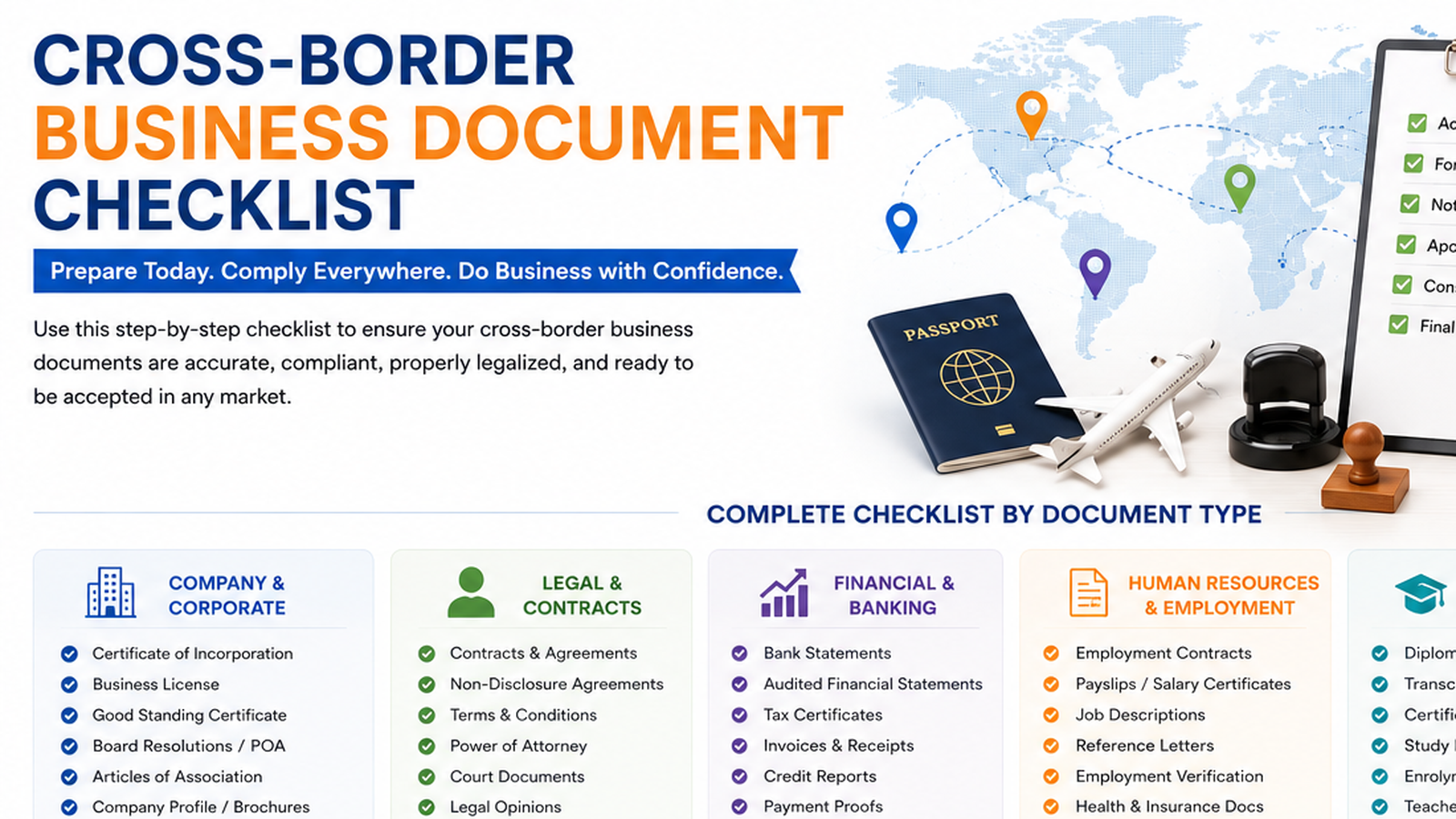
Translation, certification, notarization-related processing,
authentication or legalization may be required for some documents,
while other files may only need a clear professional translation.
The exact route depends on the destination, document type and receiving authority.
This checklist helps businesses organize a multilingual document package
before submission and identify where translation or formal document
processing may be required.
Four Questions to Answer Before Preparing the File
Who Will Receive It?
A bank, court, investor, government agency, customer or business partner
may have different document requirements.
Which Documents Are Required?
Obtain the receiving party’s checklist whenever possible instead
of translating every available company record.
What Formality Is Required?
Confirm whether ordinary translation, certified translation
or additional formal processing is required.
Which Version Is Final?
Use current signed or issued documents and prevent obsolete
drafts from entering the translation package.
Start With the Documents That Establish the Business
Cross-border transactions often begin with documents that identify
the company, its legal status, authorized representatives and ownership
or governance structure.
The exact corporate package varies by jurisdiction and transaction.
Some recipients may request only a business registration record,
while others may require resolutions, charters, powers of attorney
or evidence of authorized signatories.
Company names, registration numbers, addresses and representative names
should remain consistent across every translated document in the package.
Business Registration
Company registration, incorporation or enterprise registration records.
Charter / Articles
Articles of association, company charter or equivalent constitutional documents.
Board & Shareholder Resolutions
Approvals for transactions, appointments, investments or corporate actions.
Power of Attorney
Authorization for an individual or entity to act on behalf of the company.
Commercial Relationships Generate Their Own Document Set
Sales, supply, service, distribution, agency and other commercial agreements.
Confidentiality agreements and information-protection provisions.
Technology, software, brand, trademark and intellectual-property agreements.
Formal commercial terms used in transactions, services and online business.
Formal notices, demands, confirmations and transaction-related correspondence.
Amendments, schedules, annexes and related legal documentation.
Financial Documents Often Support Due Diligence and Funding
Banks, investors, partners and parent companies may request financial
information to assess the business, confirm transactions or support
financing and reporting.
Financial translation requires careful handling of accounting terminology,
figures, dates, currencies, reporting periods and notes.
The translation should reflect the source document rather than silently
recalculate figures or convert the financial statements into another
accounting framework.
Financial Statements
Balance sheets, income statements, cash-flow statements and notes.
Audit Reports
Auditor reports, opinions and related financial disclosures.
Bank Statements
Account information, transaction records and banking evidence.
Payment Evidence
Transfer confirmations, receipts and supporting transaction records.
Regulatory Files Should Be Identified Early
Tax identification and registration documents relevant to the business.
Tax-status, payment or compliance certificates where required.
Operating licenses, sector permits and other official business authorizations.
Declarations and records used in regulatory or business onboarding procedures.
Management, product or process certifications used in commercial qualification.
Policies, certificates and evidence of required coverage.
International Trade Creates a Separate Operational Paper Trail
Import, export and supply transactions may involve product,
shipping and commercial records in addition to company documents.
These files often contain product codes, quantities, values,
weights, specifications and references that should remain aligned
across the translated package.
The exact documentation depends on the transaction and destination,
so businesses should confirm requirements with the relevant commercial,
logistics, customs or regulatory parties.
Commercial Invoices
Seller, buyer, goods, quantities, pricing and transaction details.
Certificates of Origin
Origin information and supporting trade documentation.
Packing Lists
Packages, quantities, weights and shipment information.
Product Certificates
CO/CQ, conformity, inspection and other product-related records where applicable.
International Operations May Also Require Employee Documents
Terms of employment, assignments and personnel agreements.
Position, employment period, salary or experience confirmation.
Qualifications and experience for managers, experts and project personnel.
Academic and professional credentials supporting personnel qualifications.
Personal identification where required for authorized representatives or personnel.
Assignment letters, reference letters and other supporting employment documents.
Match Names, Numbers and Addresses Across the Entire Package
Cross-border files are often reviewed as a set rather than one document
at a time. Inconsistent company names, personal names, registration
numbers or addresses can therefore create unnecessary questions.
Before translation starts, establish the approved English or target-language
form of important names and identifiers where one exists.
Translators should preserve identifiers exactly and use the same naming
convention throughout related files.
|
TRANSLATION & FORMAL PROCESSING
Do Not Assume Every Document Follows the Same Certification Route
|
Professional translation → Confirm whether sufficient
Certified translation → Use when specifically required
Notarization-related processing → Follow applicable local procedure
Authentication / legalization → Confirm destination requirements
Original documents → Check whether originals or copies are required
|
Translation Cannot Fix an Incomplete Source File
Missing pages, cut-off seals, unreadable signatures and blurred figures
can delay translation and create uncertainty during review.
Before sending documents, check that every page is present,
readable and belongs to the correct version of the file.
For documents with stamps, seals, handwritten notes or marginal text,
scan the full page rather than cropping only the main printed content.
Complete Pages
Include every page, even where a page contains only signatures or notes.
Readable Scans
Ensure text, numbers, stamps and handwritten information can be reviewed.
Full Page Area
Do not crop seals, page numbers, margins or official markings.
Correct Version
Confirm that signed and current documents replace earlier drafts.
Keep Drafts, Signed Copies and Revisions Clearly Separated
Cross-border projects can evolve quickly. Contracts are revised,
financial reports are updated and corporate resolutions may change
before the final submission.
Clear file names and version information help prevent an obsolete
source document from being translated or included in the final package.
For larger submissions, maintain a simple document register showing
source version, translation status and final delivery status.
Cross-Border Business Files Can Contain Sensitive Information
Contracts, financial statements, bank records, employee documents
and transaction materials may contain confidential business or personal data.
Before files are shared, identify any NDA, access-control,
secure-transfer or file-retention requirements that apply to the project.
This is especially important when several external parties are involved
in the translation, certification or submission process.
NDA
Confirm confidentiality terms where required by the organization.
Access Control
Limit project access to people who need the documents.
Secure Transfer
Use an appropriate method for transmitting sensitive files.
Retention
Agree on any project-specific file-retention or deletion requirements.
Cross-Border Business Document Preparation Checklist
Obtain the document list and acceptance instructions from the receiving party.
Confirm that registrations, contracts, statements and certificates are current.
Standardize company, representative and address forms across related files.
Identify which documents and which visible elements require translation.
Confirm certification, notarization-related or legalization requirements before processing.
Check names, numbers, dates, figures, stamps, page count and completeness.
Cross-Border Business Document Translation Workflow
Requirement Review
Review destination, receiving party, document types, languages and deadlines.
Document Preparation
Confirm source quality, current versions, names and formal processing needs.
Translation & QA
Translate and review terminology, figures, identifiers, formatting and completeness.
Processing & Delivery
Complete agreed formal processing and deliver the final document package.
Related BKMOS Business Translation Resources
Understand translation and formal processing options
for documents intended for official use.
Translation of contracts, corporate documents
and other formal legal materials.
A practical guide to financial translation
for cross-border reporting and business use.
Document control for international bids,
technical specifications and commercial submissions.
A buyer’s framework for assessing expertise,
security, quality, workflow and pricing.
Financial, technical, medical, legal and other
specialist translation for international business.
Cross-Border Business Document FAQs
Which business documents usually need translation?
Common examples include corporate registrations, contracts, financial
statements, bank records, licenses, tax documents, employment records
and trade documents. The exact list depends on the transaction and receiving party.
Do all translated business documents need notarization?
No. Requirements vary by document, destination and receiving authority.
Confirm what form of translation or formal processing is actually required.
Should we translate every company document before an international transaction?
Usually not. Start with the receiving party’s document checklist
and prioritize only the records required for the specific purpose.
Why is name consistency important?
Company names, representative names, registration numbers and addresses
may appear across many documents. Inconsistent translations can create
confusion when the package is reviewed as a whole.
Can BKMOS translate financial, legal and technical documents in the same package?
Depending on the language pair and project scope, related document types
can be coordinated under one project so terminology, company information
and version control remain consistent.
What should we send for a quotation?
Send representative files, source and target languages, destination
or intended use, required processing if known, final format and deadline.
EXPERT REVIEW
Reviewed by Nguyen Dinh Phuc
Founder & CEO of BKMOS. Working in professional translation
since 2005 and responsible for BKMOS’s professional direction,
translation workflows and expert content.
This article provides a translation and document-preparation checklist.
It does not replace legal, tax, customs, banking or regulatory advice.
Requirements should be confirmed with the relevant receiving authority
or qualified professional.
Preparing Business Documents for International Use?
Send BKMOS representative files together with the target language,
destination or intended use, known certification requirements
and deadline. We will review the document package and translation
scope before quoting.
