
|
|
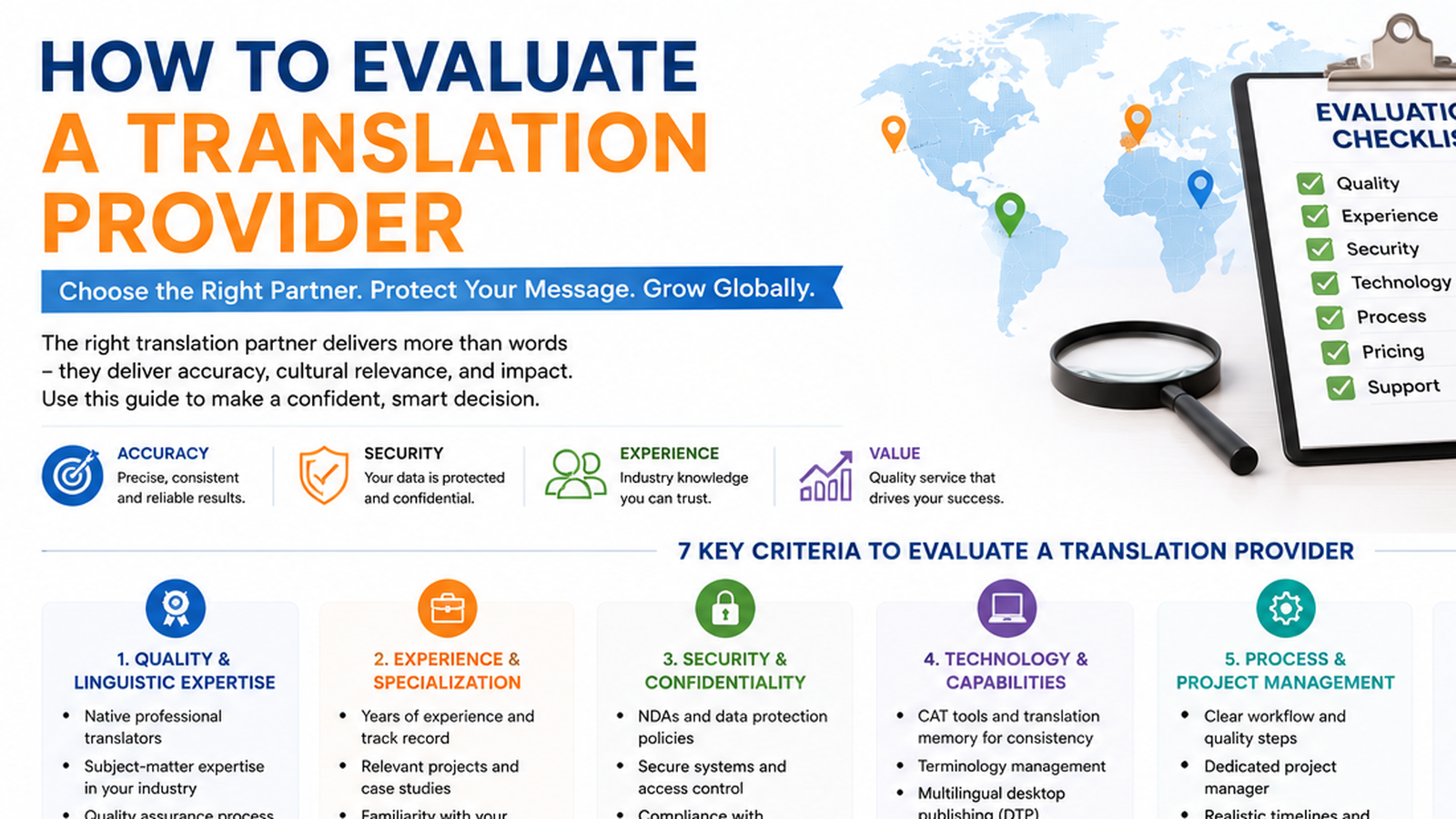
The best provider for a certified personal document may not be the same
provider best suited to a multilingual technical manual, software
localization program or recurring financial-reporting workflow.
This guide provides a practical framework for comparing translation
companies before assigning an important project or building a long-term relationship.
What Should You Evaluate First?
Relevant Expertise
Look for experience with your content type, subject matter,
language pair and intended use.
Quality Process
Ask how translation, review, terminology control and final QA
are organized for your project.
Security & Reliability
Confirm confidentiality, access control, project ownership,
turnaround and escalation procedures.
Value, Not Just Price
Compare what each quote actually includes and whether the workflow
matches the risk and importance of your content.
Know What You Need Before Comparing Providers
Translation providers cannot be evaluated fairly if the project
requirements are vague. Start by identifying the languages,
content type, volume, file formats, deadline and intended use.
Also consider whether the project needs certification, specialist
review, multilingual DTP, terminology management, confidentiality
controls or recurring updates.
A clear scope makes quotations easier to compare and reduces the
risk of selecting a provider whose service model does not fit the project.
Languages
Identify source and target languages, including any target-market variants.
Content Type
Legal, technical, medical, financial, academic, marketing or general content.
Volume & Deadline
Provide realistic page, word or file volume together with the required delivery date.
Final Use
Internal review, publication, submission, certification, localization or another purpose.
Relevant Experience Matters More Than Generic Claims
A provider may work in many languages but still lack the specialist
knowledge needed for a particular document type or industry.
Contracts, litigation, corporate records and formal legal documentation.
Manuals, SOPs, engineering specifications, drawings and manufacturing content.
Medical records, clinical terminology, laboratory results and healthcare documents.
Financial statements, audit materials, banking and business-reporting content.
Transcripts, diplomas, certificates and study-abroad documentation.
Websites, apps, software, e-commerce and multilingual digital content.
Ask Who Will Actually Translate Your Content
The quality of a translation ultimately depends on the people assigned
to the project. Ask how translators and reviewers are selected for
the language pair and subject matter.
For specialist content, language ability alone may not be enough.
The linguist should understand the terminology, document conventions
and risk level of the field.
Large providers may have broad networks, while smaller providers may
offer more direct control over individual linguist selection.
The important point is whether the assignment process is suitable for your project.
Language Competence
Confirm professional command of both source and target languages.
Subject Knowledge
Check whether the translator has relevant industry or document experience.
Target-Language Writing
The final text should be natural and appropriate for the intended audience.
Reviewer Fit
Where review is included, the reviewer should also match the project’s language and subject needs.
|
QUALITY ASSURANCE
Ask for the Workflow, Not Just the Phrase “High Quality”
|
Translation → Qualified linguist
Revision → Second-person review where required
Terminology → Project glossary / approved references
QA → Names, numbers, formatting and completeness
Final delivery → File and version check
|
Ask How the Provider Controls Repeated Language
Terminology becomes especially important in large or recurring projects.
The same product, component, account, legal term or feature should not
be translated differently from file to file without a reason.
A provider should be able to explain how client glossaries,
previous approved translations and project-specific terminology
are stored and applied.
This is particularly valuable when several translators work on the
same program or when new content is translated over many months or years.
Glossary
Approved terminology for recurring high-value terms.
Style Guide
Rules for tone, capitalization, punctuation, brand voice and formatting.
Previous Translations
Reuse approved wording where consistency with earlier documents matters.
Client Feedback
Record approved corrections so the same issue does not repeat in later projects.
Understand How Your Files Will Be Handled
Translation projects can contain personal data, contracts,
financial information, medical records, product designs
and other sensitive business information.
Ask who can access your files, how they are transferred,
whether subcontractors are used and what confidentiality
requirements apply to translators and project staff.
If your organization requires an NDA, specific data handling
or retention terms, raise those requirements before work begins.
NDA
Confirm whether confidentiality agreements can be executed when required.
File Transfer
Understand how source and translated files move between parties.
Access Control
Ask which people or systems can access confidential project material.
Retention
Confirm project-specific retention or deletion requirements where relevant.
Technology Should Support Quality and Efficiency — Not Replace Project Judgment
Translation memory, terminology tools and automated QA can improve
consistency and reduce repeated work in suitable projects.
For websites, software and large content programs, integration with
content systems or localization platforms can also reduce manual file handling.
Ask what tools will be used, how client data is handled and how
technology fits into the human translation and review workflow.
Translation Memory
Reuse approved translated segments where appropriate.
Terminology Tools
Support consistent application of project glossaries.
Automated QA
Check selected issues such as numbers, terminology and missing content.
Integration
Useful for recurring website, app and content-management workflows.
Communication Quality Is Part of Translation Quality
A clear project owner reduces confusion and keeps decisions centralized.
Files, languages, services, deadline and deliverables should be agreed before work starts.
The provider should have a practical way to raise source-text and terminology questions.
Large or urgent projects benefit from clear progress communication.
Revised source files and additional scope should be tracked clearly.
Know who handles urgent quality, schedule or commercial issues.
Compare Scope Before Comparing Price
Two quotations can show different prices because they include
different levels of review, formatting, project management,
certification or technical handling.
A low price is not automatically poor value, and a high price is
not automatically high quality. The important question is whether
the quoted workflow is appropriate for the project and clearly defined.
Ask about minimum charges, rush fees, DTP, certification,
revisions and any other costs that may apply before approving the project.
For Large Programs, a Representative Test Can Be More Useful Than a Generic Sample
Published samples can show writing quality, but they may not reflect
the people or workflow that will be assigned to your project.
For a large recurring program, a small paid pilot using representative
content can provide better evidence of terminology handling, communication,
turnaround and review quality.
The test should resemble the real project closely enough to produce useful findings.
Representative Content
Choose material that reflects the terminology and difficulty of the real project.
Same Workflow
Use the review and QA process proposed for the full program.
Clear Evaluation
Review accuracy, fluency, terminology, questions, turnaround and formatting.
Document Feedback
Record approved terminology and style decisions for future work.
|
RED FLAGS
Warning Signs to Investigate Before Awarding the Project
|
Unrealistic deadline with no scope discussion
No clear explanation of translator or reviewer selection
No defined quality or revision process
Unclear confidentiality or file handling
Poor communication before the project even begins
Pricing that cannot be reconciled with the promised scope
|
A Simple Framework for Shortlisting Providers
Weight the criteria according to your project rather than treating
every category as equally important.
Does the provider understand the language pair, document type and subject?
Is the proposed review workflow clear and appropriate to the risk?
Can the provider meet your confidentiality and file-handling requirements?
Are communication, turnaround and change control clearly defined?
Are the tools appropriate for terminology, file formats and recurring work?
Does the quote provide suitable value for the proposed scope and service level?
A Practical Translation Provider Evaluation Workflow
Define Requirements
Clarify languages, content, volume, intended use, deadline and service level.
Shortlist Providers
Compare relevant experience, workflows, security and project capabilities.
Evaluate Proposal
Review scope, assumptions, quality steps, communication and total cost.
Pilot & Onboard
For larger programs, validate the workflow and then document approved terminology and processes.
Questions to Ask Before Choosing a Translation Provider
Use this checklist to compare suppliers against the needs of
your actual project rather than generic marketing claims.
Explore BKMOS Translation Services
Technical, medical, financial, legal and other
subject-specific translation services.
Translation and formal processing support for
documents requiring certification.
Review BKMOS pricing information and factors
that can affect translation project cost.
Translation Provider Evaluation FAQs
Should I choose the translation provider with the lowest price?
Not automatically. Compare what each quote includes, the proposed quality
workflow and whether the provider has suitable experience for the content.
How important is subject-matter experience?
It can be critical for legal, technical, medical, financial and other
specialist content where terminology and document conventions affect meaning.
Should I ask for a free translation test?
For major programs, a representative paid pilot may provide more useful
evidence because it can use the real proposed workflow and project conditions.
What should a translation quality process include?
It depends on the project, but may include translator review, independent
revision, terminology checks, numerical QA, formatting review and final file verification.
Why does confidentiality matter when choosing a provider?
Translation files may contain sensitive personal, legal, financial,
medical or business information, so access and file handling should be understood in advance.
What should I send when requesting a quotation?
Send representative files, the source and target languages, intended use,
required output format, deadline and any known certification or confidentiality requirements.
EXPERT REVIEW
Reviewed by Nguyen Dinh Phuc
Founder & CEO of BKMOS. Working in professional translation
since 2005 and responsible for BKMOS’s professional direction,
translation workflows and expert content.
Need to Evaluate BKMOS for Your Translation Project?
Send BKMOS representative files together with the language pair,
intended use, required services and deadline. We can review the
project requirements and provide a quotation based on the actual scope.
