
FINANCIAL & BUSINESS TRANSLATION Financial statements are often translated when companies report A translated balance sheet, income statement or cash flow statement |
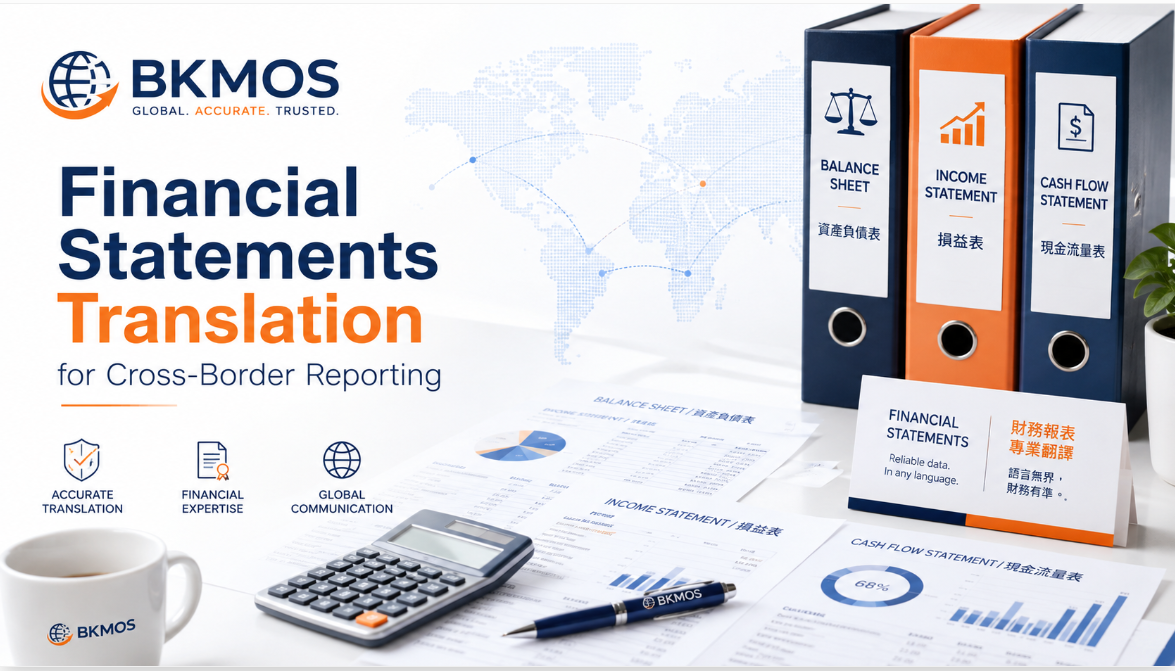
Cross-border reporting also creates practical questions about accounting
terminology, presentation conventions, notes to the financial statements,
audit wording and consistency between current and prior reporting periods.
This guide explains the main translation issues companies should review
before submitting financial statements or related reports for international use.
What Matters Most in Financial Statement Translation?
Accounting Terminology
Financial terms should be translated consistently and in the
correct accounting context throughout the reporting package.
Figures & Currencies
Amounts, percentages, dates, currency labels and numerical formats
need careful verification against the source.
Report Consistency
Headings, notes, accounting policies and recurring items should
remain aligned across the complete financial report.
Confidentiality
Financial records may contain sensitive company information and
should be handled through an appropriate controlled workflow.
What Financial Documents May Need Translation?
Cross-border reporting often involves more than the primary financial
statements. Companies may need to translate supporting notes, audit
materials, management reports and related corporate documents.
These files should be reviewed as one reporting package because
terminology, account names and references often repeat across documents.
Before translation begins, identify which files are final, which
documents are reference materials and which versions will be submitted
to the receiving party.
Balance Sheet
Assets, liabilities, equity and related account classifications.
Income Statement
Revenue, expenses, gains, losses and profit-related information.
Cash Flow Statement
Operating, investing and financing cash movements.
Notes to the Statements
Accounting policies, disclosures, explanations and supporting detail.
Translation May Extend Beyond the Core Statements
Consistency Is Essential Across Accounts and Disclosures
Financial terms frequently recur across the statements, notes and
audit materials. If the same account or accounting concept is translated
differently from one section to another, the report can become difficult
to compare and review.
Useful terminology references may include previous approved translations,
company accounting policies, chart-of-accounts terminology and wording
already accepted by the client’s finance or audit team.
A project glossary does not need to contain every word. It should focus
on recurring financial concepts and terms where inconsistency could
change interpretation or slow down review.
Account Names
Keep recurring account headings consistent throughout the report.
Accounting Policies
Use stable terminology for recurring policy language and disclosures.
Financial Ratios
Preserve labels and relationships used in financial analysis.
Audit Terminology
Handle audit wording carefully and consistently with the source context.
Financial Translation Requires More Than Language Review
A linguistically correct translation can still be unusable if figures,
dates, currencies or references are transferred incorrectly.
REPORTING CONTEXT
Translate the Report — Do Not Rebuild the AccountingThe translator’s role is to reproduce the source financial information If a receiving party requires a different presentation, accounting For translation projects, the key objective is accurate terminology, |
Accounting terminology → Translate consistently
Figures → Preserve and verify
Account classification → Do not reinterpret
Reporting framework → Follow the source context
Financial advice → Outside translation scope
|
Financial Reports Often Change Before Final Approval
Draft financial statements may be updated after internal review,
audit comments, management approval or corrections to the underlying data.
If the translation team works from an earlier draft while the finance
team updates the source, the translated report can become inconsistent
with the final approved figures or notes.
Use clear file names, issue dates and revision information, and confirm
the final source before the translated report is released.
Financial Files May Contain Sensitive Business Information
Financial statements and supporting records can contain non-public
information about revenue, costs, debt, cash position, ownership,
transactions and business performance.
Before sending files for translation, companies should consider
appropriate access controls, secure transfer methods and confidentiality
requirements for the project.
Where a confidentiality agreement or specific handling requirement is
needed, it should be raised before the translation workflow begins.
Access Control
Limit project access to the people who need the files.
Secure File Transfer
Use an appropriate method for sending sensitive financial documents.
Confidentiality Terms
Confirm NDA or project-specific requirements before work begins.
Final File Handling
Agree on delivery format and any retention or deletion requirements.
Tables and Notes Must Remain Easy to Compare
Financial reports depend heavily on tables, columns, headings,
note numbers and recurring layouts. A translation that loses this
structure becomes difficult to compare with the source.
Translation can also change text length, especially in notes and
accounting policy sections. Layout review should therefore be considered
when the translated report needs to resemble the original document.
Editable source files can make translation and formatting more efficient
than working only from scanned or flattened documents.
Tables
Maintain the relationship between headings, values and reporting periods.
Notes
Keep note numbering and cross-references aligned with the statements.
Page Structure
Preserve sections, hierarchy and document navigation where practical.
Editable Files
Word, Excel and other editable formats can simplify formatting and QA.
Financial Statement Translation Process
Document Review
Review the report type, language pair, file format, volume and deadline.
Terminology Setup
Prepare financial references, prior translations and preferred terminology.
Translation & QA
Translate and review terminology, figures, dates, currencies and completeness.
Formatting & Delivery
Review document structure and deliver the final files in the agreed format.
Before Sending Financial Statements for Translation
A short preparation step can improve quotation accuracy and reduce
revisions later, particularly when several reports or reporting periods
are involved.
Related BKMOS Translation Services
for organizations operating across markets.
and legal materials used alongside financial reporting.
or other formal processing for international use.
Financial Statement Translation FAQs
What financial documents can BKMOS translate?
Depending on the project and language pair, BKMOS can handle
financial statements, notes, audit-related documents, management
reports and related business records.
Do you convert the financial statements to another accounting standard?
Translation and accounting conversion are different tasks. The translation
should normally reflect the source report rather than silently reclassify
or recalculate financial information.
Can you keep terminology consistent across several reporting periods?
Yes. Prior approved translations, glossaries and recurring terminology
can be used to support consistency across related reports.
Should we provide Excel or Word files?
Editable files are useful where available because they can simplify
translation, table handling, formatting and numerical review.
Can financial reports be handled confidentially?
Project-specific confidentiality and file-handling requirements should
be identified before work begins so the appropriate workflow can be agreed.
What should we send for a quotation?
Send representative files, the target language, intended use, required
format, confidentiality requirements if applicable and the deadline.
EXPERT REVIEW
Reviewed by Nguyen Dinh Phuc
Founder & CEO of BKMOS. Working in professional translation
since 2005 and responsible for BKMOS’s professional direction,
translation workflows and expert content.
This article discusses translation workflow and document preparation.
It does not provide accounting, investment, tax or financial advice.
Preparing Financial Reports for International Use?
Send BKMOS your financial statements or representative sample files
together with the target language, intended use, required format and
deadline. We will review the document structure and project requirements
before quoting.
