
TECHNICAL & MANUFACTURING TRANSLATION Technical manuals and Standard Operating Procedures (SOPs) For manufacturers working across languages, even a small wording |
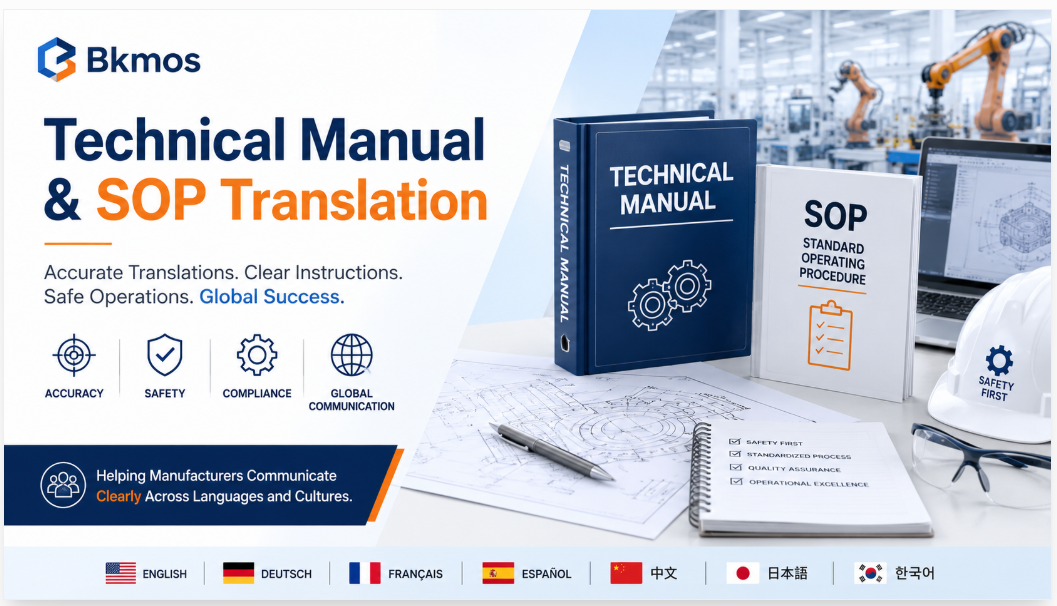
A good technical translation should preserve not only the meaning of
the source text, but also its logic, numbering, measurements, warnings,
references, terminology and relationship with diagrams or equipment labels.
This guide explains how manufacturers can prepare technical manuals,
SOPs and related documentation for translation while reducing
terminology errors, revision problems and unnecessary rework.
What Matters Most in Technical Translation?
Technical Accuracy
Terms, instructions, product references and process descriptions
should remain faithful to the source and technically meaningful.
Terminology Consistency
The same component, process or warning should use consistent
terminology across manuals, SOPs, drawings and related files.
Numbers & Units
Dimensions, tolerances, temperatures, pressures, percentages
and model numbers require careful verification.
Version Control
Technical documentation changes frequently, so the translation
workflow must stay aligned with the current source version.
What Manufacturers Commonly Need Translated
Manufacturing documentation usually extends far beyond a single
user manual. A product or production line may have separate documents
for operation, installation, maintenance, safety, inspection,
troubleshooting and staff training.
These files often share the same terminology and technical references.
Treating them as one coordinated translation project can make the
final documentation more consistent.
Before translation begins, identify which documents are current,
which files are references only and which documents will be used
directly by operators, technicians, customers or regulators.
User Manuals
Installation, operation, settings, functions and basic troubleshooting.
Service Manuals
Maintenance, diagnostics, repair, adjustment and servicing procedures.
SOPs & Work Instructions
Step-by-step procedures used in production, inspection and quality control.
Safety Documentation
Warnings, hazards, precautions, PPE requirements and emergency procedures.
Technical Content May Appear in Many Formats
Build a Technical Glossary Before High-Volume Translation
Technical terminology is often repeated across manuals, drawings,
software interfaces, spare-parts lists and SOPs. If the same concept
is translated differently from one file to another, users may assume
the documents refer to different components or processes.
A project glossary should focus on recurring and high-risk terms:
component names, process names, abbreviations, materials,
product families, model names and safety terminology.
Existing approved translations, engineering references and product
documentation can also help establish preferred terminology before
the main translation volume begins.
Component Names
Use one approved term for recurring parts and assemblies.
Process Terms
Keep production and maintenance terminology consistent across procedures.
Abbreviations
Confirm whether abbreviations should remain unchanged or be explained.
Product References
Preserve official model names, codes and manufacturer references.
Numbers Can Be as Important as Words
Technical documentation often contains measurements and values that
directly affect installation, operation or maintenance.
SAFETY & PROCEDURE CONTROL
SOPs Must Preserve Sequence, Logic and WarningsA Standard Operating Procedure is designed to guide users through Safety statements also need special attention because the difference If the source uses standardized labels or safety terminology, |
Step sequence → Preserve the original logic
Warnings → Keep severity and intent clear
Responsibilities → Identify the correct user or role
References → Keep links to forms, figures and procedures aligned
Revisions → Translate from the current approved version
|
How to Prepare Technical Files for Translation
Good project preparation can reduce questions and revisions later.
Manufacturers should provide the most current source files together
with terminology references and information about how the translated
documents will be used.
Editable files are particularly useful where manuals contain
complex tables, diagrams, labels or repeated technical content.
If engineering or quality teams will review the translation,
identify the reviewers early so terminology questions can be resolved
before final formatting.
Latest Source Files
Confirm that the files sent for translation are the current approved versions.
Editable Formats
Provide Word, Excel, PowerPoint or editable design files where available.
Reference Materials
Share previous manuals, glossaries, drawings and approved terminology.
Review Contact
Identify an engineer or technical reviewer for terminology questions when needed.
Technical Documents Change — Translation Must Keep Up
Manuals and SOPs may be revised after equipment changes, product
updates, process improvements, audit findings or safety reviews.
If translators work from an older revision while engineers update
the source, the translated document can quickly become inconsistent
with the product or process it is meant to describe.
Use identifiable file names, revision numbers and change information
so the translation team can determine what changed and which version
belongs to the final delivery.
Technical Translation Often Includes More Than Text
Manuals may contain tables, numbered procedures, screenshots,
drawings, callouts, warning boxes, cross-references and captions.
Translation can change text length, which may affect the original layout.
The final document should remain easy to navigate and should preserve
the relationship between translated text and the technical elements
it describes.
For complex manuals, translation and layout review should be planned
together rather than treating formatting as a final afterthought.
Tables
Keep headings, values and references aligned after translation.
Figures & Callouts
Ensure translated labels continue to match the correct illustration.
Warnings
Preserve visual emphasis and hierarchy for safety information.
Cross-References
Check section, figure and table references after layout changes.
Technical Manual & SOP Translation Process
Document Review
Review file types, technical field, volume, format and required deadline.
Terminology Setup
Prepare project references, terminology and client-approved naming conventions.
Translation & QA
Translate the content and review terms, numbers, instructions and completeness.
Formatting & Delivery
Review layout and deliver the final files in the agreed project format.
Before Sending Manuals or SOPs for Translation
A short preparation checklist can improve quotation accuracy,
reduce unnecessary rework and help the translation team plan
terminology and formatting requirements from the beginning.
Related BKMOS Translation Services
financial, medical and other specialist content.
declarations and documents requiring formal processing.
and legal documentation used alongside technical projects.
Technical Manual & SOP Translation FAQs
What technical documents can BKMOS translate?
Depending on the project and language pair, BKMOS can handle
manuals, SOPs, work instructions, specifications, safety documents,
technical tables and related manufacturing documentation.
Can you keep terminology consistent across several manuals?
Yes. Project glossaries, approved references and terminology
management can be used to support consistency across related files.
Do you translate text inside drawings and diagrams?
This can be reviewed as part of the project. The available source
format and the required final deliverable determine the most practical workflow.
Should we provide editable files?
Editable files are recommended where available because they can simplify
extraction, formatting and review of complex technical content.
What if the manual is revised during translation?
Revised source files should be clearly identified so the translation
can be aligned with the current document version.
What should we send for a quotation?
Send representative files, the target language, approximate volume,
required format, intended use and deadline. Reference terminology
is also helpful where available.
EXPERT REVIEW
Reviewed by Nguyen Dinh Phuc
Founder & CEO of BKMOS. Working in professional translation
since 2005 and responsible for BKMOS’s professional direction,
translation workflows and expert content.
Need Technical Manuals or SOPs Translated?
Send BKMOS your manuals, SOPs or representative sample files
together with the target language, intended use, file format
and deadline. We will review the technical scope and project
requirements before quoting.
