
ACADEMIC & STUDY ABROAD TRANSLATION Academic transcript translation is more than replacing Vietnamese For Vietnamese applicants preparing study-abroad files, consistency |
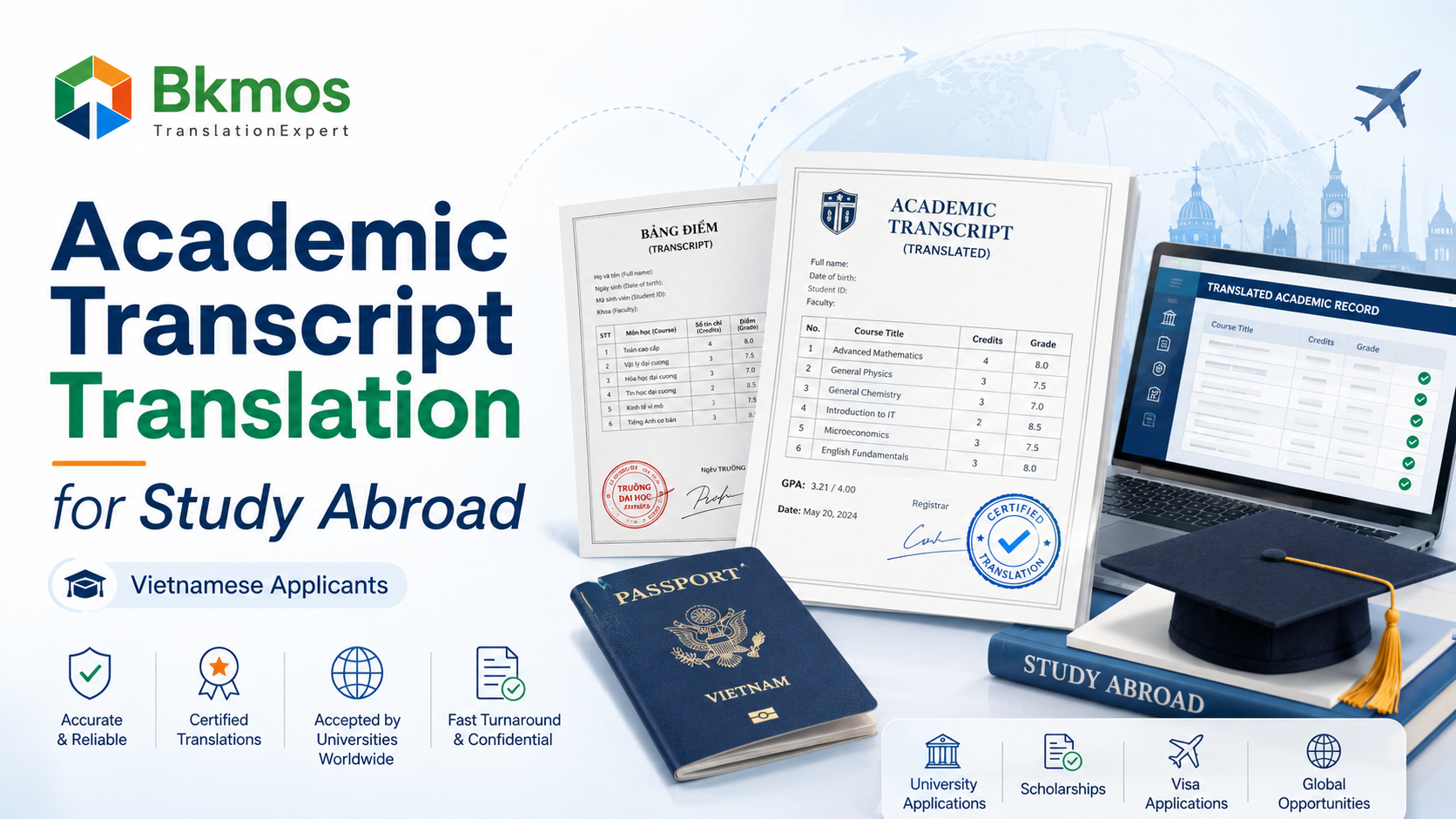
The objective is not to reinterpret a student’s academic history,
but to present the original record accurately and clearly in the
target language for the receiving institution.
This guide explains the key issues applicants should review before
submitting a translated transcript for university admission,
scholarships, credential evaluation or related study-abroad procedures.
What Matters Most in Transcript Translation?
Complete Academic Record
Subjects, grades, credits, semesters, notes and institutional
information should be translated without omission.
Accurate Course Names
Course titles should reflect the academic context of the original
curriculum rather than rely on literal word-for-word wording.
Grades & Credits
Original grades, credits and grading information should be preserved
unless a receiving authority explicitly requires conversion.
Name Consistency
The student’s name and personal details should be checked against
the passport and other application documents.
Translate the Entire Academic Record
A transcript normally contains more than a list of courses and grades.
It may also show student identification, faculty or major, academic year,
semester, credits, grading notes, cumulative results, signatures,
seals and remarks.
Omitting labels, notes or institutional information can make the
translated document difficult to compare with the original.
The translated version should therefore follow the source closely
enough that a reviewer can identify the relationship between each
original field and its translated counterpart.
Student Details
Name, date of birth, student ID and other identifying information.
Academic Program
Faculty, major, class, academic year and training information.
Course Results
Course titles, credits, marks, grades and semester results.
Official Notes
Grading notes, signatures, seals, remarks and issue information.
Course Names Need Academic Context
A course title can look simple in Vietnamese but may have several
possible English equivalents depending on the curriculum and field of study.
rather than be translated only from isolated words.
the student’s major and related technical subjects.
subjects depending on the training program.
without adding interpretation not present in the source.
small wording differences can change academic meaning.
consistently throughout the transcript and related records.
Preserve the Original Grading Information
Translators should normally reproduce the grades shown on the source
transcript rather than create an unofficial conversion to another scale.
For example, a score shown on a 10-point scale should not automatically
be converted to a 4.0 GPA unless the receiving institution or credential
evaluator specifically requires that conversion.
If the transcript contains a grading legend or classification note,
translating that information can help the reviewer understand the
original system without altering the academic result.
Keep Original Grades
Do not change marks simply to match another education system.
Preserve the Scale
Translate the grading scale or notes when they appear in the source.
Avoid Invented GPA
Do not create a GPA that is not shown or officially requested.
Keep Classifications
Translate distinctions, rankings or classifications as recorded.
Do Not Assume Credit Systems Are Equivalent
Credit values on a Vietnamese transcript should normally be preserved
as they appear on the original record.
Converting them into another credit system without an official basis
may create information that was never issued by the school.
Where a receiving institution asks for formal credit conversion,
applicants should follow that institution’s instructions or use the
credential-evaluation process it specifies.
Check the Student’s Name Against the Passport
Vietnamese names may appear in different orders or formats across
school records, passports and online application systems.
Before the translation is finalized, the spelling and order of the
student’s name should be checked against the passport or the exact
format requested for the application.
The same approach applies to dates of birth, student numbers and other
personal identifiers that appear across multiple documents.
Passport Name
Use a consistent Roman-alphabet form across the application set.
Date of Birth
Verify numerical date formats carefully to avoid ambiguity.
Student ID
Reproduce identifiers exactly rather than translating or reformatting them.
Institution Name
Use an official English name when one is reliably available.
CERTIFICATION REQUIREMENTS
Check What the Receiving Institution RequiresSome schools accept a professional translation, while others may Requirements vary by institution and procedure, so applicants |
University admission → Check application instructions
Scholarship file → Check sponsor requirements
Credential evaluation → Follow evaluator instructions
Visa-related use → Confirm document requirements
|
Problems That Can Delay Academic Applications
Academic Transcript Translation Checklist
Preparing the source documents and application requirements in advance
makes the translation process more efficient and reduces avoidable revisions.
Academic Transcript Translation Process
Document Review
Check legibility, page count, language and intended use.
Academic Translation
Translate course names, grades, credits, notes and institutional fields.
Consistency Check
Review names, numbers, academic terminology and document structure.
Delivery
Prepare the translated file according to the agreed project requirements.
Related BKMOS Translation Services
financial records and related application materials.
that require certification or notarization-related procedures.
technical and other specialized documents.
Academic Transcript Translation FAQs
Should grades be converted to a 4.0 GPA?
Not automatically. Grades and grading scales should normally be preserved
as issued unless the receiving institution or credential evaluator
specifically requires conversion.
Should Vietnamese course names be translated literally?
Not always. The English wording should reflect the academic meaning
of the course while remaining faithful to the source record.
Does the translated name need to match the passport?
Consistency is strongly recommended. The applicant should provide
the passport spelling or required Roman-alphabet form before translation.
Do transcripts always need certified translation?
No single rule applies to every institution. Applicants should check
the exact instructions of the school, scholarship provider,
credential evaluator or other receiving authority.
Can BKMOS translate diplomas together with transcripts?
Yes, related academic documents can be reviewed together so that
names, institutions, qualifications and academic terminology remain consistent.
What should I send for a quote?
Send clear scans of the documents, the target language,
intended use, certification requirements if known,
and the required deadline.
EXPERT REVIEW
Reviewed by Nguyen Dinh Phuc
Founder & CEO of BKMOS. Working in professional translation
since 2005 and responsible for BKMOS’s professional direction,
translation workflows and expert content.
Preparing a Transcript for Study Abroad?
Send BKMOS a clear copy of your transcript together with the
target language, intended use and deadline. If the receiving
institution has specific certification or submission requirements,
include those instructions so the project can be reviewed correctly.
